Molly Ivins was one of a kind. Her penetrating voice of sanity will be sorely missed.
Obits: New York Times, CNN, The Texas Observer (and its front page coverage.
Go in peace, Molly.
Molly Ivins was one of a kind. Her penetrating voice of sanity will be sorely missed.
Obits: New York Times, CNN, The Texas Observer (and its front page coverage.
Go in peace, Molly.
What does it say about me that when I was in the supermarket yesterday and saw this magazine cover:

( specifically the "Get the Body You Want" headline) that I immediately thought: "Grave Robbing"?
Via Nick Mamatas, an astonishingly stupid take on Jim Baen's publishing career:
BAEN BOOKS OFFERED AN ANTIDOTE to leftism generally in science fiction. It helped rescue science-fiction publishing from the leftist, nihilistic "New Wave" science fiction that had arisen in the 1960s and was concerned, in parallel with postmodernism and deconstructionism in other literature and art, with denigrating Western traditions and values. The "New Wave" was never really popular (New Worlds, the major New Wave magazine in Britain, was bailed out by public money after the buyers and readers stayed away in droves), but it might well have had the purely negative achievement of driving traditional science-fiction writers out of publishing. Baen Books gave -- and still gives -- a voice to stories of traditional Western values like honor, patriotism, chivalry, duty and military valor.
This is stupid in so many ways I'm not even sure where to begin. (Mamatas' post is a good start.) I guess it comes down to:
Yes, Jim Baen published a bunch of military SF, and a lot of Campbellian Engineer-saves-the-Human-Race SF (and a lot of which is quite good). But some of that military SF is written by writers like Lois McMaster Bujold and C.J. Cherryh, who hardly fit this guy's notion of a Real Science Fiction Writer, them having two X chromosomes and all. And for crying out loud, Baen published stuff by Marion Zimmer Bradley -- she of Mists of Avalon fame (or in some circles, infamy). (Note that Baen didn't publish The Mists of Avalon; Del Rey did.)
I don't know why I'm bothering to mock someone who writes for the American Spectator, in any case. Other than, well, it's fun.
I'm entirely stunned at how stupid Michael Crichton is.
He's a White-House-visiting Global Warming Denier. We already knew that.
What we didn't know is that if you piss him off, he will insert you into his next book, as a child rapist.
(!)
(Via Talking Points Memo.)
John Wilkins over at ScienceBlogs has a great explanation of The God of the Gaps, and why "Intelligent Design" people really have a very small god.
Money quote:
Those theists who think that God is an explanation only of that which we cannot explain any other way have at best a very small and limited god, one that gets pulled out of the desk drawer only when we are or want to remain ignorant of the nature of something. And that is all ID is - the desire to remain ignorant, so we can call it divine.
So I finished John Scalzi's The Android's Dream last night. Here is my report.
Bottom line: it's a light, enjoyable SF romp that trades knowingly in SF tropes and conventions and flirts with cliché in places without going over the line. It's fun. I enjoyed it.
It's not as meaty or as lean (to aim my metaphors in different directions) as Scalzi's earlier novels, Old Man's War or The Ghost Brigades. It feels less "worn smooth", which has its positives (energy and exuberance) and negatives (a feeling that the book could have been pared down by 10 or so pages, mostly in the beginning).
There are some astonishingly funny bits in the book (though it's not a comedy as such), as well as some pretty serious stuff, but overall it's light and fun.
My issues with it are somewhat nebulous -- it's hard to tell how much of them are me as a reader being my particular and peculiar self, and how much are "in the book", with others seeing the same thing. For instance, the book opens (with an interstellar fart joke, no less) with an entire chapter about Dirk Moeller, who then proceeds to not be in the rest of the book (for reasons which are obvious once you read it). I spent Chapter 1 getting into the mode of "Okay, Dirk Moeller is the protagonist, here's his backstory, and here's his setup, and whooops! there he goes."
Then we have another chapter where we get another set of potential protagonists (whose goals are in opposition to Dirk Moeller's), and then I'm all, like, "ohmygod, who am I going to root for?".
And then, only in chapter 3 do we meet the person who turns out to be our real protagonist (Harry Creek).
I feel like Chapter 1 should have been labelled "Prologue", and (part of) Chapter 3 should have been Chapter 1, and Chapter 2 could stay where it is, and the rest of Chapter 3 could be Chapter 3.
Now, this whole "who is our protagonist" theme could be considered auctorially interesting, and anyone who knows me knows that while I like nice linear storytelling, I also like weird time-slicing and multiple viewpoint stories as well. But what I really like is knowing who to root for, even if it's more than one person and they're against each other. (This is one of the reasons I hate so much of the "adultery in the suburbs" genre -- everyone is loathesome, so why bother?)
The other thing that really struck me -- forcefully, which is somewhat remarkable since I'm usually a fairly inattentive reader on these sorts of things -- is that until we meet Robin Baker (the other main protagonist), on page 116, there are basically no female characters. I think someone's mother is mentioned (possibly by name), and there's a short bit with a farmer whose wife (who we don't actually see) really doesn't like to be woken up -- but that's it. We see chunks of the US State Department, and of the US Defense Department, but there's not a woman in sight until Robin shows up -- and barely any other than her, after.
This is especially bizarre given the number of strong female characters in Old Man's War and The Ghost Brigades. Now granted, a lot of the secondary characters in The Android's Dream are criminals or military, or nerds, which as subsets of humanity, tend to the testosterone-heavy. And Scalzi is on record as explicitly mentioning Elmore Leonard as an inspiration. But still. It's somewhat weird. Or maybe I'm weird.
And there are a couple of sequences which violate my cardinal rule of technological extrapolation: don't do details, because they'll almost certainly be wrong. (If you can extrapolate technology and get it right, then you might want to think about designing new gadgets and user interfaces and building the tech, not writing SF!) The positive version of this rule states that tech details should be left as vague as possible, so things don't date too badly. (Nothing dates as badly as last year's consumer user interface.[1])
The last bit of ranting I'll do is about a major (and nearly literal) deus ex machina that is threaded throughout the book. There's a long rant about how arrogant AI people are (which is true), which concludes with the "obvious" way to make an AI (copying an existing brain), which no one (in the book) has thought of. Well, it's a great deus ex machina as it's written, but it's also silly to posit a SFnal world where no one has thought of this, since in our world, lots of people have thought about how to upload their brains into computer simulations. Clearly The Android's Dream exists in a parallel universe where Ray Kurzweil, Greg Egan, and a bunch of other people (including Frederick Pohl, who "vastened" Gateway's Rob Broadhead in Heechee Rendezvous all the way back in 1984) never existed. What I really wish Scalzi had done was explain that lots of people had tried this, but no one had succeeded, and then explain how clever this particular uploaded AI's uploader was.
What can I say? I'm a science and computer geek. Things like this bug me.
Wow, I just spent ten paragraphs criticizing a book I really enjoyed reading. What's up with that? Well, if John Scalzi is interested in a nitpicking science and computer geek to help keep him out of trouble, he can consider this my audition. (Yeah, like he's going to be reading this.)
Or maybe I'm simply still annoyed at him for linking to this, which (as I mentioned a few posts ago), has eaten up way too much of my time. Damn you, Scalzi!
[1] Some notable non-consumer interfaces, like good command line interfaces, age very well indeed.
One, for this online game (which I found via Scalzi's "By the Way" blog). Possibly the best use of Flash ever.
WARNING: this is highly addictive. I wasted spent way too much time today on level 11.
Two, for making me (yes, making me, with the mighty power of his blogging!) pre-order The Android's Dream twice. I hadn't realized I'd already pre-ordered it the second time I went to pre-order it, so I ended up with two copies. If I enjoy it as much as the other ones he's written, I'll probably be sending one of them to someone I like as a Christmas gift. (If I don't enjoy it, I'll send it to someone I dislike.)
Our big cat Meph (Mephistopheles) died today. He was diagnosed with advanced metastatic squamous cell carcinoma last week, and was beginning to really show signs of pain and distress, so we took him to the vet today and made his passing as painless as possible.
In his honor, then.
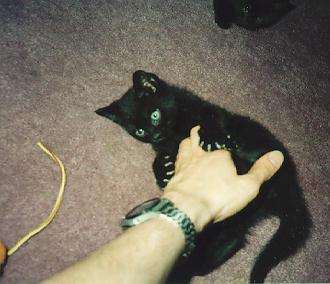
As a little little kitten -- but look at those paws! (He maxed out at 18.5 pounds, but was down to a svelte 14.5 this summer, and was far far too skinny at the end.)
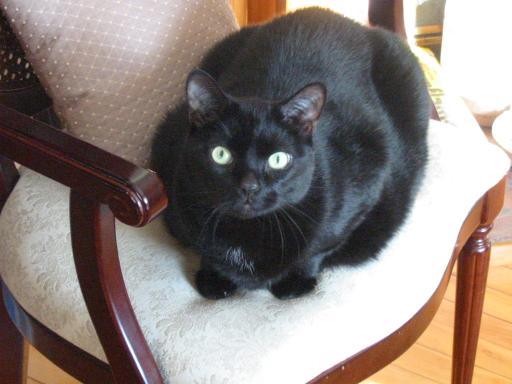
As an adult, taking up a human-sized chair:
And two pictures of Meph at his goofiest:
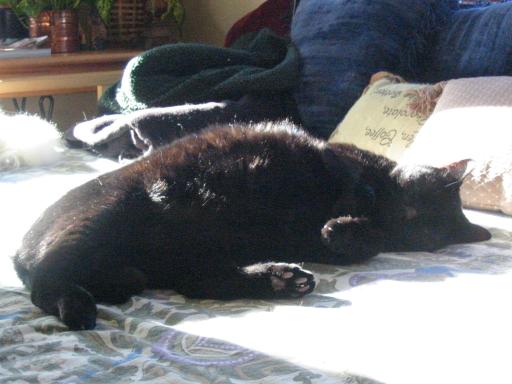
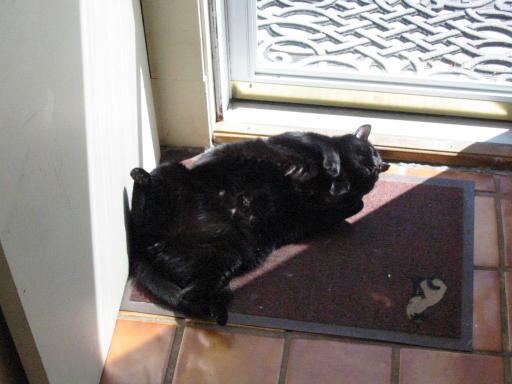
We're going to miss you, Meph.
Letterman eviscerates Bill O'Reilly. Money quote:
O'Reilly:It isn't so black and white, Dave — it isn't, 'We're a bad country. Bush is an evil liar.' That's not true.
Letterman: I didn't say he was an evil liar. You're putting words in my mouth, just the way you put artificial facts in your head!
This time, it's this story of a 19-year-old who disabled a carjacker/kidnapper by crashing the car. (The kidnapper/carjacker was not wearing a seatbelt.)
I can't be the only one who immediately thought of Larry Niven's "The Deadlier Weapon", can I? And my wife, when I mentioned the story to her, immediately thought of the season 1 finale of Veronica Mars.
Does no one read O. Henry any more? I'm saddened that no one mentioned "The Cop and the Anthem" in this AP story, titled "Jobless man asks judge for jail time".
If there's any phrase I wish I could insert into the national political consciousness, it would be trust laundering.
It's the perfect way to tie all of the Republicans together into one neat package, so we can toss them overboard all at once. The Foley cover-up scandal is the perfect mimetic carrier for this.
This provides a simple rhetorical hook to allow us to talk to moderate Republicans and unaffiliated people who have voted Republican in the past:
"No matter how decent or moderate or reasonable your local Republican Representative or Senator is,", we can say, "they still vote in the Republican caucus, and elect as their leaders people like Dennis Hastert and John Boehner, who have been covering for a sexual predator. They take your trust, and then, just like money laundering, they hand it up to their leadership, who abuses it."
The trust laundering goes farther, of course: the Republicans in Congress further launder this trust to support (some might say lie down for, or even bend over for) a President whose handling of the country a large majority of the population disapproves of.
The list of Bush's faults isn't worth getting into here (and it's probably preaching to the choir), but if you know someone who disapproves of Bush's handling of the country, but still feels it reasonable to vote for a Republican Representative or Senator because that Republican is a decent person, ask them "would a decent person support someone who covers for sexual predators?"
Via Slashdot a few days ago: Steven Levy on the secrets of the iPod shuffle. Executive summary: the iPod "shuffle" feature really is random, but since our big hairless ape brains are supreme pattern finders, we see patterns where there are none.
Most interesting tidbit:
But the non-randomness illusion was so prevalent that ultimately Apple felt compelled to address it. In the version of iTunes rolled out in September 2005, there appeared a new feature: smart shuffle. It presents iPodders with a scroll bar that "allows you to control how likely you are to hear multiple songs in a row by the same artists or on the same album". If you pull the lever to the right, the iPod will mess with its usual distribution pattern, intentionally spacing out songs by a given artist. As Jobs explained it in his presentation the day the new iTunes rolled out, he gave what he hoped would be the last word on the Great iPod Randomness Controversy: "We're making it less random to make it feel more random."
This is something that's driven me nuts for years: random does not imply equally distributed. In fact, it's randomness that leads to us seeing patterns. To borrow an example from Stephen Jay Gould, think of constellations: evenly distributed stars would not have any patterns -- they'd be in a grid or something. It is, in fact, the bunchiness that comes from a random distribution that leads to patterns emerging.
An example:
While I was a grad student at Harvard, the Administration (headed by the Dean, who was a computer scientist [remember this]) decided to switch to pure random placement of non-freshmen into the Harvard Houses. The previous placement method had been a weird ad-hoc system of "non-ordered choice", with a random component to spice things up; this had in turn replaced "ordered choice", which had replaced "apply to the House and see if the upper class twits would accept you". Or some such wonderfully egalitarian system.
In any case, while I was there (and a Tutor in Leverett House, if you're curious), It Was Decided that non-ordered choice had to go. (My interpretation: under non-ordered choice, a significant number of black students managed to end up living in the same House. And that Was Not To Be Borne.) So they went for random choice. (Ironically, one of the major justifications for it was "It's the way that Yale does it", which strikes me as simply insane, since Harvard's justification for 95% of everything else it does is "We're Harvard, we're not like other places, and especially we're not like Yale.")
In the Random Choice method, each freshman would join a rooming group (of up to 20 students) and rooming groups would be randomly placed in a House. Details of The Placement Algorithm were tightly guarded. (Clearly it couldn't be pure randomness -- the Houses all had different capacities and whatever assignments were made had to fit the number of rooms.)
The first year after they implemented the Random Choice method, they ended up with Houses with drastically skewed gender ratios in their sophomore cohorts: the combination of the large rooming groups (which were largely single-sex) and the random placement meant that some Houses got a lot more men than others, and some few got equal numbers of men and women. (Harvard was one of the last universities in the country to reach gender parity in its student body, and it hadn't yet done so at that time, so no House got more women than men, as far as I know.)
There was a great kerfluffle. Perhaps even a hullaballoo. "How could the gender ratios gotten so far off?" came the cries, with much rending of garments. "It was random!"
Because, you see, random does not imply equally distributed. Especially for small numbers.
Now the Dean of Harvard at the time, you may recall (if you read carefully above -- you didn't realize there was going to be a quiz, did you?) was a computer scientist. One of the major problems in computer science is the generation of random (or more accurately pseudo-random) numbers. It undergirds all cryptography, after all. So my question for years has been: how the heck did Harvard's computer scientist Dean not understand this?
Clearly, being a Harvard professor may mean you're smart, but it doesn't mean you're wise.
John Scalzi blogged about Twenty Epics a couple of months ago. I thought it sounded interesting (the structuring conceit of the anthology is that each story tells an epic tale in 10,000 words or less), but this was in the middle of our two-weddings-and-a-funeral summer, so I more or less forgot about it.
A short while ago, I got back in touch with a friend I had fallen out of touch with, and it turns out he had a story published in Twenty Epics. When I found that out, I went and ordered the book immediately, read his story first, and quite enjoyed it. I then read the rest of the stories, and other than one or two which were a little too elliptical for my taste, I enjoyed them all.
So if you like epics you can read in less than half an hour, go get yourself a copy and enjoy. Or not. De gustibus non est disputandum.
Go read this interview with John Hodgman, and then go watch his bits from The Daily Show, especially Net Neutrality, White Minority, and Bush's Tax Cuts.
UPDATE: I forgot to add Hodgman's blog. So there it is.
A friend asked me for my list of Important SF Books. I posted one last week.
Which of course, means that I need to post a list of Important or just Favorite fantasy books.
To quote from the SF books post:
Note: this is a list that skips lots of things; this is my list, after all, and I may well have missed something in my scan of my bookshelves (I reserve the right to add things later!). While I think that all of these are Important, these are also ones I enjoy, so there are other Important books I did not include. Some of these were historically important but are dreadful to read now, or which I wouldn't want to re-read.
I'll leave the hair-splitting to others about what SF and Fantasy are, and where their boundaries lie. I include some Horror here, and put some "steampunk" (like China Miéville's stuff) here, but you should feel free to disagree with me on that one.
Anyone looking for good books to start on should look at the World Fantasy Awards or the Mythopoeic Fantasy Awards.
UPDATE: Edited the Prydain entry to be clearer. (Hi, Colorwheel. :-))
UPDATE: I'd like to add The Once and Future King by T.H. White, and The Princess Bride, by William Goldman. (Thanks go to someone who shall remain nameless, but who knows who he is.)
The ABC "Docudrama" (note, not a documentary) about 9/11 just gets worse and worse the more we hear about it. As related here, even people who've worked for Bush are calling bullshit.
The thing that really burns me about this is that the RoviansRepublicans are getting away with this, after spending months in 1998 blaming Clinton for "wagging the dog" by attacking al Qaeda camps in Afghanistan, ostensibly to divert attention from the Monica Lewinsky scandal.
I want to see one Republican (or hell, one Democrat) stand up and say publically "I was wrong to criticize President Clinton about that".
A friend (you know who you are -- hi!) asked me for my list of Important SF Books. So here it is.
Note: this is a list that skips lots of things; this is my list, after all, and I may well have missed something in my scan of my bookshelves (I reserve the right to add things later!). While I think that all of these are Important, these are also ones I enjoy, so there are other Important books I did not include. Some of these were historically important but are dreadful to read now, or which I wouldn't want to re-read.
Also: there is no fantasy in this list; I'll do that later. (I'll leave the hair-splitting to others about what SF and Fantasy are, and where their boundaries lie. To quote my wife, "I know what I mean.")
Anyone looking for good books to start on should look at the Hugo and Nebula Award winners.
Updates:
I was reading Standards and specs: Not by UNIX alone, which is a nice article on Unix software development. It made me pull out an older rant of mine and polish it up for this blog.
Software companies build a fundamentally different thing from hardware companies.
To most people, this is so obvious that it shouldn't even need to be stated. In the obvious ways, Most People are right. But there are non-obvious ways in which this is importantly true.
Toyota or Ford don't actually have to make next year's models "interoperate" with this year's models. I'm not even sure what "interoperate" would mean in the context of cars, beyond "they have to use some version of unleaded gas, and be able to fit on the roads, park in garages (I'm talking to you, Ford Excursion) and have the same user interface -- steering wheel, accelerator & brake pedals, etc.".
Auto companies can make everything else about their cars change from year to year.
They don't, of course -- there are strong rewards to not changing too much too fast, and for sharing ("conserving", in the genetic sense) parts within a product line -- both temporally (last year's model and this year's model have a lot of the same parts) and organizationally (our luxury model uses most of the same parts as the base model). But if someone wanted to radically change their engine without touching their car body or interior at all, they could. In fact, that's basically what Honda did with their Hybrid Civic. Looks just like every other Civic on the road, except for the little "Hybrid" sigil on the back.
In the same way, computer companies could radically re-engineer their hardware (motherboards, peripherals, CPUs) as long as they look the same to the rest of the world (e.g. programs). This is what Intel and AMD do every time they bring out a new product line. (Well, these days. The 286 to 386 jump was a doozy.)
But software? Software is a totally different thing. It has to interoperate. The lateral interoperation (between co-existing hardware) isn't that important to some software producers -- Microsoft deliberately engineers incompatibilities all over the place to keep the Mac a second-class computer -- but temporal interoperation, that's a big one. The Office 95/97 incompatibilities burned Microsoft pretty badly, although they'll never admit it.
This is arguably the defining distinction between the Unix and Microsoft worlds.
Most Unixes are built, maintained, and pushed forward by one of two groups:
Microsoft is a (relatively) hardware-agnostic software-only company (notwithstanding the Xbox or the Microsoft Mouse or Keyboard). Windows runs on most Intel x86 hardware.
Guess which set of software producers has sold the most incompatible versions of software?
Okay, that's a no brainer.
Apple navigated the 680x0 to PowerPC migration in the early 1990s quite well; I'm sure they'll handle the PowerPC to Intel migration just as well. Stuff will Just Work -- on expensive Apple-only Macs, but it'll Just Work. Mostly.
Unix is a weird case for a lot of people, I think. I remember doing a Sun 3.7 to 4.0.1 OS migration, which also involved a 68020 to SPARC 1 hardware migration at the same time. We had specialized video capture hardware to deal with, including all sorts of special code to drive it. We simply recompiled everything, and except for a few little things, it all Just Worked. Try that going from Windows 3.1 to Windows 95, or 95 to NT.
There are programs written in the early 1980s which would compile directly on any modern Unix these days. They might need a little tweaking for header files or libraries, but they'd Just Work. A lot of this is the whole command-line vs. GUI issue (all our fancy Unix boxes still act like they're talking to VT100 terminals from 1978, which in turn are not all that different from actual teletype machines from the 1950s -- cf. In the Beginning was the Command Line). The Unix programming model is so clean and spare, it has barely changed (regardless of what's under the hood in the OS) -- the clean separation of functionality and coherent interfaces simply make it Just Work.
Unix has a long history of having things layer on top of each other -- things continue to Just Work. Contrast this with Windows, which changes radically (and disruptively) every few years. That might be calming down; Windows 2003 seems to be more like "Windows 2000, but done right this time" than a totally new OS. But the Home edition of it (XP) still has some idiotically disruptive things in it compared to 2000. E.g. the My Computer and My Documents links disappear off the desktop. The claim is that having everything under the Start Menu makes it easier to learn Windows. That may be true, but it's sure annoying to someone used to Windows 2000. Sure, you can tell it to look like Win2k, but you still have to manually tell it to put My Computer and My Documents back on the Desktop. Stupid!
This is one of those clear cases where Microsoft is trying to make software the way that auto companies make cars -- "next year's model can be different because it'll be a new batch of people". Except it's not. The software market is a lot more mature than it was 10 years ago when Windows 95 came out. It's a lot closer to saturation. Even most home users are buying upgrades, not a first computer. And businesses? Wasn't Windows supposed to be the business OS? (Macs, of course, are the long-haired arty-farty computers.)
Businesses that plan for the future (i.e. businesses that will be around for the future) do not buy new OSes and throw the old ones away. They migrate: they have different versions coexisting. As much as it'd be nice to simply rip out everything and rebuild, it's simply impossible to do. If you have a big IT installation (and especially if you're providing a service, like web pages or email, or VOIP or something), you simply cannot do that. Won't work. You have to evolve, not revolve.
Any OS that makes it hard to migrate from one version to the next is a real pain. Unix is simple. It all Just Works. It has its pains, but it usually Just Works at this level.
Windows? Ha. This is an OS that doesn't have to worry about long-term OS uptime because urgent security patches come out monthly and therefore no box is going to be up longer than a month, because so many patches require a reboot. There are Solaris boxes at my company that have been up for 3+ years without breaking a sweat.
To summarize: software is NOT like hardware. It's not like automobiles, or appliances, or anything else that people replace. Software lives a lot longer than any single piece of hardware, has to play nice with other software, and most importantly, has to play nice with its descendants. The entire idea of "next year's model" is absurd and idiotic when it comes to software. There's only the next version. And that version MUST play nice, or you're going to piss people off.
It's entirely unclear to me if any Windows admin (who hasn't used Unix for any length of time) understands this. I'm guessing no.
It's entirely unclear to me if anyone at Microsoft truly knows this, either. Or is it just that if they understood it, they wouldn't be able to market their stuff without wanting to kill themselves in shame?

