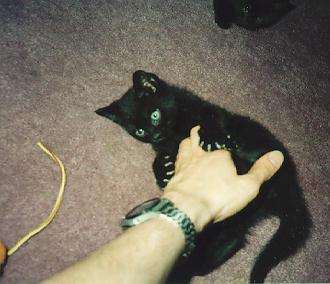
Saturday, June 16, 2007

Reviews 2007-06-16: Non-Fiction Books

I'm way behind on writing up what books I've read. This is non-fiction books.

In this roundup:

  • 1421: The Year China Discovered America, by Gavin Menzies
  • Programming the Universe, by Seth Lloyd
  • Parasite Rex, by Carl Zimmer
  • How Doctors Think, by Jerome Groopman
  • Better, by Atul Gawande
  • Stumbling on Happiness, by Daniel Gilbert

Gavin Menzies' 1421: The Year China Discovered America is a great companion to 1491: New Revelations of the Americas Before Columbus (which I reviewed previously). The book subtitle is "The Year China Discovered the World" for the non-American editions. (<insert snarky comment about stupid Americans here>)

Menzies starts his book with an account of how he found a map dated authoritatively to 1424, which showed islands that he eventually deduced were Puerto Rico and Guadeloupe -- including a notation that there was a volcano on Guadeloupe, which matched geological evidence that there had been an eruption between 1400 and 1440 - and not for a hundred years before or after. He started looking at more and more old charts and maps, and kept finding evidence that the European explorers had accurate charts of diverse parts of the world (including Antarctica!) long before they actually visited them. He came to the conclusion that only China could have done the original charting at that time -- no one else had the technology or the manpower to do it.

Menzies is a retired British submarine commander, and has experience crucial to being able to work with the old charts and maps he was investigating -- hands-on experience navigating by stars (especially in the southern hemisphere) as well as first-hand knowledge of currents and charting from near-sea-level.

After a short introdcution, the book starts off with an account of China in 1421: Emperor Zhu Di, third Ming Emperor, opened the just-completed Forbidden City in Beijing (hosting leaders and potentates from all over southern Asia and eastern Africa), and launched a huge fleet of trade/tribute ships (commanded by eunuchs loyal to the emperor), to first take back all the leaders who had come to Beijing and then to chart the world and bring it into China's tribute system.

While the fleet was away, though, lightning started a fire the destroyed much of the Forbidden City, which led to a revolt amongst the Mandarin class (who had been push aside by Zhu Di). The Mandarins, pointing to the fire as evidence that the Mandate of Heaven had been withdrawn from Zhu Di, took power, and closed China. When the trade fleets returned, they were burned to the waterline and all documentation that could be found was destroyed.

What became clear to Menzies was that what little documentation -- some charts and maps -- remained, leaked westward until it was picked up by the Portuguese and Spanish, who used it to their advantage when exploring. Magellan claimed to his mutinous crew to have a chart showing that the Straits of Magellan were actually a strait -- narrowly averting the mutiny. Columbus and his brother made a distorted copy of a world map that showed Africa and Malaysia both extending much further south than they actually do, and used that to convince the Spanish Crown that the Portuguese were in for a rough time looking for an eastward route to the Spice Islands -- and thus the westward route was worth trying. Prince Henry the Navigator ordered his fleets to find the islands they'd seen on a chart ("Antilia" and "Satanaze" -- modern-day Puerto Rico and Guadeloupe).

Menzies, details his slow deciphering of old charts (mostly copies of other, even older charts), and his slow realization that some of these are stunningly correct about parts of the world that Europeans had never seen at that point. (One fascinating example of this is a map that shows what we now call Patagonia, which included drawings some of its now-extinct megafauna. Another is a map of Africa which becomes accurate once ocean currents are taken into account -- the chart was most probably drawn with dead-reckoning as the measurement method; factoring in the current that goes up the west side of Africa and then turns west around the bulge, the map is accurate.)

The book has dozens of examples and a huge amount of detail about the four giant fleets that China sent out in 1421 -- they went all across the Indian Ocean, and thence around to the Cape Verde Islands, where they rendezvous'd and then commenced huge charting expeditions. Menzies believes that there were upwards of 800 ships involved, some of which were 400 feet long. (In contrast, the Santa Maria was about as long as my house.) In addition to the charts, there are a large number of pieces of archaeological, linguistic, and sociological evidence which can at least tentatively be explained by Chinese visitation or even colonization around the world.

Some of the examples seem seriously stretching (there's a claim that Navajo elders in the early 1900s could understand Chinese, which seems really weird to me), but if even half -- or even a third -- of the possibilities connected to Chinese voyages of discovery, it would be an amazing discovery.

Fundamentally, there's nothing outlandish (or even surprising) about the idea that Chinese seafarers made it to the Americas or had charted most of the world -- China in the early 15th Century, after all, was decades if not centuries ahead of the rest of the world technologically and scientifically. But the idea that they might have charted the world, and then thrown it all away, is just mindblowing. But the Mandarin closing of China is (ironically) fairly well documented, and any such voyages of discovery could easily have been wiped out of the official historical record. (Far stranger things have happened.)

The documentary evidence in European archives -- letters between the Columbus brothers, Magellan's claims to his sailors, and so on -- are in many ways the most convincing, although a few archaeological sites (like a wreck buried in the sands in the Sacramento river turning out to be a Chinese Junk) would be well-nigh incontrovertible. The drama of this discovery is still unfolding -- a lot of data is still being brought to light. Menzies has a web site, www.1421.tv, which includes recent finds and corroborating data.

Bottom line: fascinating subject and an entertaining book. The book could have been edited a bit better, and I really wish that more diagrams had been included -- like "before" and "after" versions of charts with the currents included. I also wished for more of the actual detective story in addition to the results. But overall, highly recommended.


Seth Lloyd's Programming the Universe was a disappointment. It's hard to tell if it would be disappointing to other people, though, because it's about the physics of the Universe being a computer. Being a former physicist and current computer geek, I figured this would be right up my alley, but it turned out to be far too vague for me on both the physics and the computing. It may be that someone for whom both subjects were relatively unknown would feel more enlightened.

Bottom line: I was bored by it, but you might not be.


Carl Zimmer's Parasite Rex is a collection of essays that Zimmer put together in 2001. It feels more like an interconnected set of essays than a book, which isn't always bad, but this seemed like a rough joining job. That being said, I really like Zimmer's writing (he blogs over at scienceblogs.com too), and there's a lot of fascinating (if potentially disgusting) things in here.

From the life cycle of malaria to liver flukes, there are a lot of weird life forms out there, and Zimmer's central point -- that scientists have neglected parasites -- is well supported. Some of his more speculative ideas (that lack of parasites in first world countries lead to increased allergies and other immune system disorders) are less well supported, but are quite plausible and seem like great areas of further research.

Bottom line: recommended if you have a strong stomach.


It seems like every other doctor in Boston is writing a book these days, and Jerome Groopman is one of the better ones. I've been reading his articles in The New Yorker and other places for a while now, and almost always enjoy them. How Doctors Think is Groopman's long meditation on the number of ways that doctors can mis-think, mis-diagnose, and otherwise mess up when treating patients.

The book is a good read. It's mostly anecdotal in approach, and while each episode is fascinating, I ultimately wanted some higher-level wrapup or framing for the various cognitive issues that Groopman is addressing.

Bottom line: a good read, but not the best thing in the world.


Atul Gawande's Better: A Surgeon's Notes on Performance is another of the Boston-doctor-written books (he's also a New Yorker writer), and it's a very good book indeed. Gawande is for my money a better writer than Groopman -- better on the word-by-word, sentence-by-sentence level (he approaches poetry sometimes), and better on the integration of large and small scales of focus. Better is about efforts to make health care, well, better. His critical eye ranges from attempts to make doctors actually wash their hands (a truly scary chapter for anyone who knows someone who's been in the hospital recently) to the effort to eradicate polio in India, taking in along the way doctors involved in capital punishment, what kind of money doctors make, and how army physicians have achieved astounding results saving lives in Iraq.

All through the book, it's clear you're in the hands of someone who is humane and cares deeply about both the systemic, emotional, moral, ethical, and, well, human dimensions of the practice of medicine. It's one of the best nonfiction, non-history books I've read in a long time.

Bottom line: highly recommended.


Daniel Gilbert's Stumbling on Happiness is a survey of the current understanding about how humans make -- and fail to make -- themselves happy. It's mostly about how we fail to understand what does make us happy, and how we mis-predict how we'll feel in the future and how we felt in thte past. It's a solid addition to the "wow, this data is totally counterintuitive -- our intuition sucks" genre.

I enjoyed reading this book a lot, but while I read it most recently of all the nonfiction books reviewed here, I really don't remember much about it. The amount of detail was overwhelming. One thing that did stick with me was the study that showed (based on highly granular emotional-state self-reports) that men and women react very similarly emotionally -- but later on, they drastically differ in their memory and categorization, with men de-emphasizing emotional reactions and women over-emphasizing them.

There's a lot of great detail in the book, and I think I'm going to have to re-read it to make it stick. Perhaps, though, I've forgotten most of it because to remember it would destroy my carefully-wrought defense mechanisms that I use to avoid predicting correctly what I've felt in the past and how I'll feel in the future.

Bottom line: recommended.


To summarize:

BookWriterRating (out of 5 stars)
1421: The Year China Discovered AmericaGavin Menzies4.7
Programming the UniverseSeth Lloyd3.0
Parasite RexCarl Zimmer4.0
How Doctors ThinkJerome Groopman4.0
BetterAtul Gawande4.6
Stumbling on HappinessDaniel Gilbert4.3

Home Inspection Nightmares

This Old House has a new gallery of Home Inspection Nightmares. (This is volume 6; there are links to earlier ones.)

I'm literally stunned at the kind of stuff people do to their houses.

Linked in honor of people I know who have just closed or are about to close on houses.

Sunday, June 10, 2007

Movie Review Roundup #2

It's time for another installment of Movie Review Roundup!

In this issue:

  • The Departed
  • The Good Shepherd
  • Jarhead

First up: The Departed, which I saw on the LimoLiner bus to NYC. It's a fantastic cast (Matt Damon, Mark Wahlberg, Leonardo DiCaprio, Martin Sheen, Alec Baldwin, and Jack Nicholson in the various leads, with a bunch of solid backup in the rest of the cast. It's very well-made, enjoyable to watch, and gratifyingly bang-y for the buck at the end. It's not the best movie ever made, and it probably wasn't really the Best Picture of last year (although it sure was better than Crash), but it was darn good. And they actually filmed Boston pretty well.

Bottom line: good, solid mob/cop movie with a stellar cast.


Apparently this is Matt Damon week, because I also watched The Good Shepherd recently. This is a very well done but awfully depressing movie which should be subtitled "How Skull & Bones Fucked Up the World". It follows Matt Damon's character, Edward Wilson, from 1939 (being inducted into Skull & Bones) as he works in the OSS during World War 2 and then helps set up the CIA, all the way through 1962, after the Bay of Pigs fiasco.

Good news: Robert DeNiro can actually direct.

Bad news: Robert DeNiro can't edit down as far as he should. The movie was about 20 minutes longer than it needed to be, I think. Also, I think casting Angelina Jolie as Wilson's unloved socialite wife was probably a mistake -- it makes it much harder to believe some of what goes on, because she's so damn hot.

Bottom line: good movie, but not one I'd see again.


Jarhead is one I've been meaning to see for a while, and we finally watched it yesterday. I enjoyed the book a lot, although I found it a little scattered. The move is less scattered; they linearized the plot and (of necessity) removed a bunch of details. I think this actually is a bad thing in a lot of ways. (They got Catch-22 to work as a movie, even with the insane time-jumping, but maybe Mike Nichols is a better director than Sam Mendes, or Buck Henry is a better screenwriter than William Broyles.)

Jake Gyllenhaal is a good actor, but I'm not sure he's right to play Swofford in this movie. On the other hand, the supporting cast is great -- Peter Sarsgaard's habitually flat affect actually works well here, and Jamie Foxx is great. The relative unknowns rounding out the rest of the cast do a good job too.

Ultimately, though, the movie seems kind of random and annoying in ways that the book did not, and it was fundamentally unsatisfying.

(It doesn't help that it was a stark reminder of when a President George Bush prosecuted a war in the Middle East with actual planning and multilateral cooperation.)


To summarize:

MovieQuality Rating (out of 5 stars)Enjoyability Rating (out of 5)
The Departed4.14.4
The Good Shepherd4.03.5
Jarhead3.53.8

Irony, thy name is Bork

Robert Bork, spurned Supreme Court nominee and noted supporter of tort "reform" sues the Yale Club of New York City for $1M + punitive damages, because he slipped and fell there when giving a talk.

I really can't add much to that.

Via Making Light.

Sunday, June 03, 2007

Way Too Accurate

This will hit close to home for anyone who ever played D&D.

Via Pharyngula.

Saturday, June 02, 2007

Today's Moment of Self-Reflexivity

I was reading Michael Bérubé's latest post at Crooked Timber, and he made reference (semi-ironic as is his wont) to a Bourdieu Chart. I wasn't familiar with that term, and went and google'd it -- and the first thing that came up was Michael Bérubé's latest post at Crooked Timber.

Perhaps Google should replace one or both of its "o"s with ourobouroses. (Ouroubouri? Ourobouropodes?)

Sunday, May 27, 2007

Kangaroos Self-rooing

I had no idea kangaroos did that.

Movie Review Roundup

I've watched a number of movies (on DVD, mostly) recently, and I figured I'd do some quick writeups. Since most of these movies have been out for months if not years, I figure I don't have to worry about spoilers.

In this roundup:

  • X-Men 3: The Last Stand
  • Kinky Boots
  • Children of Men
  • Happy Feet
  • Stranger than Fiction
  • Armageddon

First up: X-Men 3: The Last Stand, which I saw last night with Dan. Simply put, this was entertaining and pretty to watch, but ultimately brain candy, because they made the characters act so stupidly.

Case in point: if you're Magneto, and you can actually move the Golden Gate Bridge with your mind, and you want to destroy something on Alcatraz, why not simply drop the bridge on Alcatraz, rather than landing one end of it on the island, and then having your cannon-fodder minions run off of it into the enfilading fire of the US Army?

And poor Famke Janssen. All she gets to do for most of the movie is stand around and look either (a) miserable or (b) dangerous or (c) both. Oh, I guess she gets to kiss Hugh Jackman too, so she got to do something useful.

Bottom line: recommended as a fun DVD watch, but check your brain at the door.


Kinky Boots is one of those little English movies that no one should ever try to remake as an American movie (but they might try anyway). Based on a true story, it's about a guy (Charlie, played by Joel Edgerton) who can't wait to get out of Northampton and his father's shoe business, and ends up back there running it when his father dies suddenly.

Based on a chance encounter with a transvestite lounge singer named Lola (Chiwetel Ejiofor, stealing yet another movie), Charlie decides that the way to save the factory is to retool and make man-sized thigh-hugging kinky boots for transvetites. Hilarity and exquisitely gauged English embarrassment ensues.

Bottom line: a very fun little movie which I enjoyed even more than I'd hoped. Strongly recommended.


Children of Men is a visually fascinating, subtly acted depressing movie which I actually enjoyed a lot. Directed by Alfonso Cuarón (rapidly becoming one of my favorite directors), the entire movie is played low-key and hyper-realistic, which makes it all the more disturbing.

Basic plot outline is that sometime in our near future (2009 or so) people stop being able to have children (in the book, it's explicitly male infertility, which brings up the obvious "what about sperm banks" question; the movie sidesteps the cause of the infertility). Twenty-odd years later, society is coming apart at seams, and England has turned itself into a fortress to keep out unwanted types (like displaced Germans, in a nice twist).

Clive Owen (one of my favorite actors) plays Theo, a competent but disaffected guy who gets roped into a crazy scheme by his ex-wife Julian (played by Julianne Moore, possibly the only mis-casting in the movie), who heads up a radical group who are harboring a young woman (Kee) who is miraculously pregnant; they want Theo to get her to the coast where she can join up with some shadow organization that can keep her safe.

Betrayals and double-crosses ensue as Julian's group unravels (in part due to her lieutenant Luke -- played by Chiwetel Ejiofor, yet again stealing a movie), and Theo loses ally after ally as he and Kee try to make it to the coast for their rendezvous.

The movie is fairly elliptical, and doesn't actually explain a lot, but it's very well put together, and the picture of 2027 is extremely well done -- just enough change to be odd and interesting, not so much that it's crazy, and everything looks actually used. Also, it's got Michael Caine in a wonderful supporting role.

Bottom line: depressing as hell, but really well made. Recommended but not for people who weep easily.


Happy Feet was possibly one of the stupidest movies I've ever seen. It follows the antics of Mumble, an Emperor Penguin who can't sing (and thus can never get a mate), but who can (and does) tap dance. He's kicked out of the tribe because that makes him, you know, weird. On his adventures he discovers that their food supply is being picked up by weird creatures in big ships.

A lot of noise was made by right-wingers that this was a parable about gay people. I just don't see it. Mumble (voiced by Elijah Wood) wants a girl penguin -- a particular one voiced by Brittany Murphy. It's all about the boy-girl stuff. All his adventures are aimed at the goal of getting the girl.

Then there's the weird pseudo-environmental stuff: Mumble ends up captured by humans and put in an aquarium, where his tap-dancing convinces humans to stop over-fishing Antarctic waters.

The message seems to be that if you're cute, you can convince humans to stop kicking your ass. Otherwise, get out of the way.

And I wonder how many people, having seen this movie, actually think "Ah, problem solved.".

The only funny thing in the movie is Robin Williams as the leader of a set of Adelie penguins. And even that's diluted by having him also voice a different penguin (who has set himself up as a sort of oracle).

Bottom line: totaly incoherent, unfunny, and boring. Skip it.


Stranger than Fiction is a cute little movie which shows that Will Ferrell may actually be able to act. Ferrell plays Harold Crick, a numbers-nerdy IRS auditor who starts hearing a voice narrating his life. We the viewer find out that this is the voice of Karen Eiffel (played by Emma Thompson, making a potentially horribly unlikeable role quite sympathetic), a reclusive author, famous for killing off her protagonists, who is in the midst (or even throes) of writing her latest novel, which stars one Harold Crick.

Crick is assigned the task of auditing a baker played by Maggie Gyllenhaal; the least believable thing about the movie is that they fall for each other. Meanwhile, Crick consults psychologists and ends up talking to a professor of literature played by Dustin Hoffman (amiably chewing the scenery).

The movie probably could have been a few minutes shorter, and not every piece of the conceit works, but it was a fun little movie. My biggest complaint is that Queen Latifah (playing an assistant to Emma Thompson's author, sent by the publishers to get her back on track) didn't get enough screen time.

Bottom line: I enjoyed this little movie. A good DVD view.


Armageddon has been out for nearly ten years, and I finally saw it. This is without a doubt one of the stupidest movies I've ever seen. I feel like every Hollywood blockbuster should be required to have physics major (sophomore or above) vet the script before it goes into production.

Quick rundown: Ben Affleck can't act, Bruce Willis phoned it in, they wasted Jason Isaacs entirely, and the best reason to watch this movie was Steve Buscemi.

Bottom line: feh.


To summarize:

MovieQuality Rating (out of 5 stars)Enjoyability Rating (out of 5)
X-Men 33.03.8
Kinky Boots4.24.6
Children of Men4.64.3
Happy Feet1.21.2
Stranger Than Fiction4.04.2
Armageddon2.03.0


An oddity of this set of movies is that Joel Edgerton was in Kinky Boots with Chiwetel Ejiofor, who was in Children of Men (and also Inside Man, though they shared no scenes) with Clive Owen, who was in King Arthur with Joel Edgerton (who played Gawain).

Saturday, May 26, 2007

I'm never driving with the windows down again....

I know I keep posting things I see on Scalzi's "By the Way" blog, but this one is amazingly interesting.

How to Drive Like a Cop. Full of fascinating and (to me) non-obvious tips from the people who drive fast. A lot.

Tuesday, May 22, 2007

Never underestimate the bandwidth of...

FedEx has a higher bandwidth than the Internet. Of course, the latency is terrible.

This isn't surprising, given that the information density of disks has increased way faster than bandwidth speeds.

There's an old sysadmin quote: "Never underestimate the bandwidth of a station wagon full of tapes hurtling down the highway." That's usually attributed to Andy Tanenbaum.

I once drove a pile of full NetApp disk shelves from Boston to NYC and calculated that my bandwidth was around 100Mbps (much faster than our inter-city links at the time).

Via Scalzi.

Monday, April 23, 2007

Why Do We Keep Calling it the Iraq "War"?

Why do we call it the Iraq "War" still?

It's not a war. War is armies fighting armies. This is our Army (and Marines, and National Guard) fighting insurgents in a country whose armed forces we defeated and then disbanded. A country we conquered.

And of course, we know it's not a War because its Mission was Accomplished:

We need to call this what it is: the Iraq Occupation.

Air Conditioners: an underappreciated goad to exercise

It's 80 degrees Fahrenheit at 11:48 am.

I'm lugging my office A/C unit up three flights of stairs. I'm wheezing badly.

I am horribly out of shape.

Wednesday, April 18, 2007

Thursday, April 12, 2007

Lee Iacocca Opens a Can of Whup-Ass

Lee Iacocca has a new book, and man is he pissed. Here's a scathing excerpt. Worth reading, to remind you of when Republicans were actually based in reality....

(Via Scalzi.)

Wednesday, April 11, 2007

Matryoshka Doll Packaging

So we ordered a glass-fronted bread box from Williams-Sonoma. (We had had a stainless-steel one, but when it was closed it just looked like another appliance and we'd always forget we had bread in there. Stupid perceptual systems.)

It came today, in a box that seemed a bit large. I sliced it open with a box-cutter, put the box cutter away, opened the box, and found

Another corrugated cardboard box, surrounded by foam packing peanuts. I grumbled, got the box cutter out again, spent three minutes trying to get the inner box out of the pool of peanuts without spreading the foam peanuts all over the kitchen, finally got it out, sliced it open, and opened the second box to find
A third corrugated cardboard box, surrounded by large-bubble bubble wrap. Once this was out, I used the box cutter again (having learned my lesson and keeping it out of the tool drawer) and found
The display box (which you'd see at the store, I guess), nestled perfectly inside the third corrugated cardboard box. Pulling this out was difficult because it fit so perfectly that there was actually an audible hiss and then pop as I finally got it out. Opening that box (which required two cardboard tabs and several flaps) showed me
A plastic bag wrapped around -- finally --
The f***ing bread box.

Crazy.

Saturday, March 31, 2007

Republicans are Pro-Troops like they're Pro-Child

Thought for the day:

Republicans spend a lot of time saying that their opponents don't "support the troops". They also say that they (the Republicans) are "pro-life" and "pro-child". They do seem to be "pro-troop" in about the same measure as they are "pro-child". Here's a quick rundown of their positions:

"Pro-Child""Pro-Troop"
We need lots of children so we don't get overrun by brown people. We need lots of troops so we don't get overrun by Muslims (who are mostly brown).
But I mostly care about other people having kids. But I want it to be other people's kids going off to fight.
I only care about children till they're born. I only care about the troops till they're deployed.
Education and health care for born children is optional. Training, armor, and health care for deployed troops is optional.
Cutting (really) rich people's taxes is more important than actual children. Cutting (really) rich people's taxes is more important than actual troops.

Wednesday, March 28, 2007

Chimeras!

Synchronicity is hitting me today. I ran across this article in Nature (linked via slashdot) about a pair of twins who aren't identical twins nor fraternal twins -- they're both chimeras. One of them is a "true hermaphrodite" (having both ovarian and testicular) tissue. This leads to an obvious question: how many intersex children are chimeras?

(And how many anti-science right-wingers heads are exploding over this? It's got a bunch of stuff they clearly can't handle: science, evolution, gender ambiguity.)

And then there was article in the New York Times (linked via Carl Zimmer's blog) that details the discovery that marmosets are almost invariably chimeras -- they are almost always fraternal twins who basically hybridize at the cellular level in utero.

The world is far stranger than we could ever imagine.

Sunday, March 25, 2007

Shpaahtans!

I saw 300 last night with Dan and a crew of others. (This is not a movie to see with only one other person -- you need a crew.)

Quick responses:

It's an enjoyable eye-candy flick, though clearly not for everyone. ("It's about the battle of Thermopylae. You know, a date movie.").

This is what all the political posturing and kerfluffle is about? What a slender reed, to carry all that weight.

Gerard Butler (as Leonidas) is impressive, but his Scottish accent slipped in a number of times, making him sound almost as out of place as Sean Connery playing an Egyptian-by-way-of-Spain in Highlander. "Shpaahtans! Tonight...we dine...on haggis!". Or something like that.

The most over the top moment: the narration at the very end. It might have made sense in the graphic novel, but there are moments where you have to actually break from your source material.

Abs!

Dan and I agree that Lena Headey and more importantly her costumes have knocked Princess-Leia-in-a-bronze-bikini off the nerd pedestal.

After the 30th or 40th "sword time" shot (in analogy to the Matrix's "bullet time" -- start a shot in normal speed, slow down to show dismemberment or impalement, then speed up as the blood spurt flies off), that got a little, well, boring.

I feel sorry for the foley artists (sound effects people) who had to come up with the hundreds (thousands?) of blood squelches. Eeuuww.


More seriously, I pretty much agree with Aram (and his linkage to Penny Arcade) that there is a clear political context to the movie coming out now. It's just unclear how that plays out, is all. I mean, the U.S. invaded Iraq -- does that make Bush Xerxes?

Update: best mashup trailer ever. (Via Will Shetterly.)

Friday, March 23, 2007

I am never the first to think of something

I should get used to this. I will never be the first to think of something. Or at least, something cool that anyone other than, say, my boss would care about.

Case in point: I was listening to the radio a few days ago, really half-listening, probably in the kitchen making lunch, and someone says "semi-automatic weapons". Because I was not really fully listening, and because I'm, well, weird, my brain parsed that as "semiotic weapons".

Semiotic weapons. What a great phrase! I could build an SF story around that. (Unless Iain M. Banks already has -- Use of Semiotic Weapons? Or maybe he named a ship that at some point.) Or it could be a great name for a punk band. Or...wait a second....

Sigh. (Okay, this query only gets 53 hits, instead of 466,000, but still.)

Once again, I am way behind the times.

Monday, March 19, 2007

Possibly the Nerdiest Thing I've seen in Weeks[1]

Bub, bar cher flap!.

[1] Short of the email thread at work today comparing the oldest files we have in our homedirs -- mine date from my first day at work, over ten years ago.)

Saturday, March 17, 2007

Review Roundup

I've read a number of books and recently (and some not so recently), and I figured I'd do some quick writeups.


First up: China Miéville's Un Lun Dun. This is Miéville's first novel aimed at young adult readers. He acknowledges his inspirations in the acknowledgements, including Neil Gaiman, who seems to hover over the first third of the book like some inverted Marley's ghost. Once past that part (mostly setup and exposition), though, Miéville hits his stride, and so does the book.

The story follows two London girls, Zanna and Deeba, who find themselves drawn into an alternate city, UnLondon (which has counterparts Parisn't, No York, Lost Angeles, and Romeless). Zanna, it seems, is the Shwazee (a bastardization of choisee, the Chosen One), who, it is prophesied, will save UnLondon from great evil.

At some point, this neat standard alternate-world urban fantasy goes off the smoothly greased rails, the Gaiman hommage dissipates some, and things get really interesting.

Favorite bit: animals apparently can move back and forth between London and UnLondon at will (so they all stare at Zanna, 'cause, you know, she's the Shwazee); all except cats, who it turns out are really stupid and only care about looking cool, not about anything like the survival of the world against great evil. Oh, and watch the giraffes.

Least favorite bit: the pun magic. It's funny once, but as a system of the world, it can get infuriating if it's not deftly handled. I felt a bit bludgeoned by it in the first third of Un Lun Dun, but it got better later.

Bottom line: recommended.


Spring Forward: The Annual Madness of Daylight Saving Time. I had bought this last year, but finally got it off my shelf last weekend, while grumbling about the stupidity of moving the daylight-savings-time shift date.

The book is basically a light history of Daylight Saving Time (note: not Daylight Savings Time -- it's a timekeeping that, when in effect, is saving daylight, not banking savings of daylight).

The most obvious bizarrity of the story is the sheer number of different political players that have pushed for (or against) DST changes to benefit themselves. Obvious candidates: the New York Stock Exchange, which kept NYC doing Daylight Saving Time so they would have an hour of overlap with the London Stock Exchange (London later returned the favor, resisting Double-Summer time); the candy manufacturers, who wanted DST to start in November, so that Halloween would stay light later (they got their wish in this latest round); farmers (often blamed for DST although they in fact resisted it mightily); golfers; and Richard Nixon (who imposed year-round DST in 1973/1974 -- I vividly remember my mom driving my brother and sister to school [and me to preschool] in the dark; now I actually know why).

Perhaps the most vivid thing about the book is that it illustrates how insane timekeeping was (and still is) in the US and around the world. If nothing else, computers have made it effectively impossible to go back on that. I hope.

Bottom line: recommended for anyone who is interested in little corners of history.


The Ghost Map by Steven Johnson. I am a fan of Johnson's blog, and this book doesn't disappoint. It's a retelling of the classic urban planning story about stopping a cholera epidemic in London, with the legend teased apart, explained, and expanded.

It's not for the delicate of stomach (London in 1854 was apparently a really disgusting place), but it's a fascinating story, and Johnson has an ear for illuminating anecdotes to go along with and illustrate the main story.

My only real complaint is that the book seems a bit loose -- like it's not sure whether to be a straight forward detective story or a day-by-day history or what. That's minor, though.

Bottom line: recommended for anyone interested in cities.


I read 1491: New Revelations of the Americas Before Columbus by Charles C. Mann last year, and was mightily impressed. I just picked up the paperback version (having given my hardback copy to a friend), which includes a new afterword. I re-read the first and last chapters again for good measure.

This is a fascinating book, and an exemplar of the "passionate amateur synthesis" genre. It puts together 50-60 years of research in varied fields (mostly New World Archaeology) and paints a compelling picture of North and South America before the collision with European culture (and most importantly, its germs).

If there's any criticism I have of the book, it's that it doesn't label as well as it might which presentations are established facts, which are well-established and widely-accepted theories, and which are contentious hypotheses. (It does do some of that, but it's hard to tell if it does enough.)

Overall, though, it's a fascinating and mind-blowing picture of North and South America filled with tens (if not hundreds) of millions of people, with highly complex civilizations that were wiped off the map by smallpox and other virulent diseases that the invading Europeans were more immune to. These were civilizations that are only now coming to light because (a) by the time settlers made it into the center of the continent, the civilizations had long since collapsed and been overgrown; and (b) Indians Are Noble Savages, don't you know?

The sheer scale of the societies that existed in the Americas before Columbus's voyages is amazing. Anyone interested in humanity should read this book. Anyone interested in SF should find this fascinating from the standpoint of first contact situations. The "what if" stories or obvious and multitudinous. What if the indigenous Americans had been more disease resistant? (A couple hundred guys with guns will only go so far against millions of well-armed warriors with longbows -- see also Jared Diamond's Collapse, specifically the section where he talks about the Vikings who landed in Labrador and tried to get a foothold -- they ran off, basically saying "Stay away! Those guys are fierce, and dangerous, and don't want us there!"). What if there had been endemic disease in the Americas that had gone back to Europe and spread across the "Old World" as pandemically as smallpox did in the "New World"? I leave other scenarios as an exercise for the reader.

Bottom line: highly recommended.


To summarize:

ObjectArtistRating (out of 5 stars)
Un Lun DunChina Miéville4.0
Spring ForwardMichael Downing3.9
The Ghost MapSteven Johnson4.5
1491Charles C. Mann4.9

Thursday, March 15, 2007

Okay, I Concede. GMOs are a Bad Idea. Especially by Monsanto.

Aram has been mocking me for years for my optimism that GMOs could be useful. Well, I formally throw in the towel on this one.

Scientific American is reporting that Monsanto has a GMO corn that causes liver and kidney damage, and that they knew about this and marketed it anyway.

In my defense here, I always said it was a bad idea to trust the company that brought you dioxin and aspartame.

Monday, March 05, 2007

Clever Passwords Considered Harmful

I currently have a set of really nifty passwords, so nifty in fact that I really want to show off how clever they are. Which kinda sorta entirely defeats the purpose of having passwords.

Must. Resist. Urge. To. Show. Off. Niftiness. Of. Passwords....

Sunday, March 04, 2007

IT Folks, the Advice Columnists Have Your Back

In today's Boston Globe Magazine, the "Miss Conduct" advice column has this sidebar:

What computer people wish everyone knew: Asking an IT professional to take a look at your malfunctioning laptop (for free) is akin to asking a doctor for medical advice at a cocktail party. And not all "computer people" do the same thing. Asking a Web designer to fix your malfunctioning hard drive is like asking a lawyer for medical advice at a cocktail party.

I think we IT geeks are finally <sniff> accepted!

Thursday, March 01, 2007

Go Kiwi Geeks!

If WETA wasn't geeky enough for you, try out this heartwarming tale of a Kiwi engineer who made his own broadband link out of a $10 wok.

Brilliant.

Tuesday, February 27, 2007

This Explains A Lot

Last week's New York magazine had a fascinating cover story about the effects of praising children.

The gist is that if you praise kids for being smart, rather than for working hard, they don't do as well, and in fact give up more readily, while kids praised for working hard rise to challenges more resiliently. The effect is pronounced and visible immediately.

This explains an awful lot. It explains a large number of people I saw in college (way more years ago than I care to admit now), and a lot of people at the dot-com where I started working at the leading edge of the bubble. It also explains a lot about my wife's (high-school) students.

Of course, everyone always thinks the next generation is callow and stupid and whiny and all that. But still. This time we have data.

Monday, February 19, 2007

Idiocracy

I watched Mike Judge's Idiocracy on DVD yesterday, and while it was no Office Space, it's still an amusing way to spend an hour and a half.

The plot setup of the movie is that Joe Bauers (Luke Wilson, playing a low-echelon army librarian who is dead-average on all measures, including IQ), and Rita (a similarly dead-average prostitute [she's a prostitute for the slimmest of plot threads]) are put into hibernation coffins, ostensibly for a 1-year tes sleept. Due to a bunch of mistakes, they wake up 500 years later instead.

In the intervening 500 years, the story goes, the average intelligence has plummeted because stupid people breed so much faster than smart people -- such that Joe and Rita are the smartest people in the world. The future is garbage dumps the size of cities, gatorade knock-offs replacing water, and Jackass-type shows ("Ow! My Balls!") as the height of pop culture. You know, fiction.

The movie was released in a tiny number of theaters (reports vary on the number), for a week, before being dumped to DVD. This might have something to do with the sheer trashing of major corporations (Fuddruckers morphs into Futtbuckers, and thence to Buttfuckers, Starbucks becomes a brothel chain, and so on).

I'm hardly the only one to remark on the similarity of the movie's plot setup to C.M. Kornbluth's "The Marching Morons" (and "The Little Black Bag"), first published in 1951. That's only in the plot setup, though. Kornbluth's story, which posits a few million "elite" smart people running the world behind the scenes while the billions of "normals" think that it is they who are running it, is actually much darker and nastier than Idiocracy.

By the way, I strongly recommend against googling "idiocracy kornbluth". That seems to pick up every insane right winger who ever read (and seemingly masturbated to) the Kornbluth story. I'm still feeling nauseated after reading some of those.

Saturday, February 17, 2007

Greetings Fellow Drivers

Via BoingBoing: you can trick out your car with a device that plays audio files over your horn. It only holds eight audio files, but that's probably enough.

I've been wanting this product for years. My choices would be

  • "I would like to pass."
  • "The left lane is for PASSING", in that 1950s documentary voice
  • "Green means GO", in the same 1950s documentary voice
  • "Your left turn signal has been on since the battle of Verdun" (documentary voice)
  • "Asshole!" -- Kevin Kline from A Fish Called Wanda

I'm sure I can come up with a few more over time, but those are the ones I really want now.

What would you want?

Sunday, February 04, 2007

Greetings, Zetetical Society

A warm Blogospherical welcome to the Zetetical Society Meeting Notes. (Also added to blogroll.)

Why isn't it elench.zetetical.org, though, just to make the Iain M. Banks reference? <grin>

Saturday, February 03, 2007

Charles Stross is a GOD. Or at least a Demi-god. Or maybe a Fiend.

WARNING: Geek content ahead. Get ready to roll a saving throw.

A friend likes to tweak me about our years playing Dungeons and Dragons, especially our fascination with some of the more obscure Fiend Folio creatures. (The new Fiend Folio cover is hideously Harry Potter-ized. Feh.)

So he sent me some snark about whether I remembered what githzerai were. I could only remember that they were related to (or next to in the Fiend Folio) githyanki, which is one of my favorite names from the entire D&D bestiary. (Not least because I can make stupid jokes to annoy my friends, like "Githyanki." "You're welcome." <rimshot>)

I of course went googling and found the githzerai WikiPedia entry, which mentions that they were invented by Charles Stross. This was a major surprise, because Charles Stross is now a hotshot SF writer whose stuff I've been reading recently, and enjoying immensely. (I strongly recommend The Atrocity Archives, especially if you've ever been a sysadmin.)

I feel like I've come full circle in some deep way. Some incredibly nerdy, sex-and-dating-impairing, deep way.

Thanks, Charles Stross!

Wednesday, January 31, 2007

Blog at Half-Mast: Molly Ivins, RIP

Molly Ivins was one of a kind. Her penetrating voice of sanity will be sorely missed.

Obits: New York Times, CNN, The Texas Observer (and its front page coverage.

Her columns.

Go in peace, Molly.

Sunday, January 21, 2007

Braaaaains.....

What does it say about me that when I was in the supermarket yesterday and saw this magazine cover:

( specifically the "Get the Body You Want" headline) that I immediately thought: "Grave Robbing"?

Thursday, January 11, 2007

Jaw-Dropping Drivel

Via Nick Mamatas, an astonishingly stupid take on Jim Baen's publishing career:

BAEN BOOKS OFFERED AN ANTIDOTE to leftism generally in science fiction. It helped rescue science-fiction publishing from the leftist, nihilistic "New Wave" science fiction that had arisen in the 1960s and was concerned, in parallel with postmodernism and deconstructionism in other literature and art, with denigrating Western traditions and values. The "New Wave" was never really popular (New Worlds, the major New Wave magazine in Britain, was bailed out by public money after the buyers and readers stayed away in droves), but it might well have had the purely negative achievement of driving traditional science-fiction writers out of publishing. Baen Books gave -- and still gives -- a voice to stories of traditional Western values like honor, patriotism, chivalry, duty and military valor.

This is stupid in so many ways I'm not even sure where to begin. (Mamatas' post is a good start.) I guess it comes down to:

Yes, Jim Baen published a bunch of military SF, and a lot of Campbellian Engineer-saves-the-Human-Race SF (and a lot of which is quite good). But some of that military SF is written by writers like Lois McMaster Bujold and C.J. Cherryh, who hardly fit this guy's notion of a Real Science Fiction Writer, them having two X chromosomes and all. And for crying out loud, Baen published stuff by Marion Zimmer Bradley -- she of Mists of Avalon fame (or in some circles, infamy). (Note that Baen didn't publish The Mists of Avalon; Del Rey did.)

I don't know why I'm bothering to mock someone who writes for the American Spectator, in any case. Other than, well, it's fun.

Thursday, December 14, 2006

Michael Crichton Is Not Just an Idiot, he's a Libelous Idiot

I'm entirely stunned at how stupid Michael Crichton is.

He's a White-House-visiting Global Warming Denier. We already knew that.

What we didn't know is that if you piss him off, he will insert you into his next book, as a child rapist.

(!)

(Via Talking Points Memo.)

Sunday, November 19, 2006

"God of the Gaps" explained

John Wilkins over at ScienceBlogs has a great explanation of The God of the Gaps, and why "Intelligent Design" people really have a very small god.

Money quote:

Those theists who think that God is an explanation only of that which we cannot explain any other way have at best a very small and limited god, one that gets pulled out of the desk drawer only when we are or want to remain ignorant of the nature of something. And that is all ID is - the desire to remain ignorant, so we can call it divine.

Thursday, November 09, 2006

Review: The Android's Dream

So I finished John Scalzi's The Android's Dream last night. Here is my report.

Bottom line: it's a light, enjoyable SF romp that trades knowingly in SF tropes and conventions and flirts with cliché in places without going over the line. It's fun. I enjoyed it.

It's not as meaty or as lean (to aim my metaphors in different directions) as Scalzi's earlier novels, Old Man's War or The Ghost Brigades. It feels less "worn smooth", which has its positives (energy and exuberance) and negatives (a feeling that the book could have been pared down by 10 or so pages, mostly in the beginning).

There are some astonishingly funny bits in the book (though it's not a comedy as such), as well as some pretty serious stuff, but overall it's light and fun.

My issues with it are somewhat nebulous -- it's hard to tell how much of them are me as a reader being my particular and peculiar self, and how much are "in the book", with others seeing the same thing. For instance, the book opens (with an interstellar fart joke, no less) with an entire chapter about Dirk Moeller, who then proceeds to not be in the rest of the book (for reasons which are obvious once you read it). I spent Chapter 1 getting into the mode of "Okay, Dirk Moeller is the protagonist, here's his backstory, and here's his setup, and whooops! there he goes."

Then we have another chapter where we get another set of potential protagonists (whose goals are in opposition to Dirk Moeller's), and then I'm all, like, "ohmygod, who am I going to root for?".

And then, only in chapter 3 do we meet the person who turns out to be our real protagonist (Harry Creek).

I feel like Chapter 1 should have been labelled "Prologue", and (part of) Chapter 3 should have been Chapter 1, and Chapter 2 could stay where it is, and the rest of Chapter 3 could be Chapter 3.

Now, this whole "who is our protagonist" theme could be considered auctorially interesting, and anyone who knows me knows that while I like nice linear storytelling, I also like weird time-slicing and multiple viewpoint stories as well. But what I really like is knowing who to root for, even if it's more than one person and they're against each other. (This is one of the reasons I hate so much of the "adultery in the suburbs" genre -- everyone is loathesome, so why bother?)

The other thing that really struck me -- forcefully, which is somewhat remarkable since I'm usually a fairly inattentive reader on these sorts of things -- is that until we meet Robin Baker (the other main protagonist), on page 116, there are basically no female characters. I think someone's mother is mentioned (possibly by name), and there's a short bit with a farmer whose wife (who we don't actually see) really doesn't like to be woken up -- but that's it. We see chunks of the US State Department, and of the US Defense Department, but there's not a woman in sight until Robin shows up -- and barely any other than her, after.

This is especially bizarre given the number of strong female characters in Old Man's War and The Ghost Brigades. Now granted, a lot of the secondary characters in The Android's Dream are criminals or military, or nerds, which as subsets of humanity, tend to the testosterone-heavy. And Scalzi is on record as explicitly mentioning Elmore Leonard as an inspiration. But still. It's somewhat weird. Or maybe I'm weird.

And there are a couple of sequences which violate my cardinal rule of technological extrapolation: don't do details, because they'll almost certainly be wrong. (If you can extrapolate technology and get it right, then you might want to think about designing new gadgets and user interfaces and building the tech, not writing SF!) The positive version of this rule states that tech details should be left as vague as possible, so things don't date too badly. (Nothing dates as badly as last year's consumer user interface.[1])

The last bit of ranting I'll do is about a major (and nearly literal) deus ex machina that is threaded throughout the book. There's a long rant about how arrogant AI people are (which is true), which concludes with the "obvious" way to make an AI (copying an existing brain), which no one (in the book) has thought of. Well, it's a great deus ex machina as it's written, but it's also silly to posit a SFnal world where no one has thought of this, since in our world, lots of people have thought about how to upload their brains into computer simulations. Clearly The Android's Dream exists in a parallel universe where Ray Kurzweil, Greg Egan, and a bunch of other people (including Frederick Pohl, who "vastened" Gateway's Rob Broadhead in Heechee Rendezvous all the way back in 1984) never existed. What I really wish Scalzi had done was explain that lots of people had tried this, but no one had succeeded, and then explain how clever this particular uploaded AI's uploader was.

What can I say? I'm a science and computer geek. Things like this bug me.

Wow, I just spent ten paragraphs criticizing a book I really enjoyed reading. What's up with that? Well, if John Scalzi is interested in a nitpicking science and computer geek to help keep him out of trouble, he can consider this my audition. (Yeah, like he's going to be reading this.)

Or maybe I'm simply still annoyed at him for linking to this, which (as I mentioned a few posts ago), has eaten up way too much of my time. Damn you, Scalzi!


[1] Some notable non-consumer interfaces, like good command line interfaces, age very well indeed.

Tuesday, November 07, 2006

Damn you, Scalzi!

One, for this online game (which I found via Scalzi's "By the Way" blog). Possibly the best use of Flash ever.

WARNING: this is highly addictive. I wasted spent way too much time today on level 11.

Two, for making me (yes, making me, with the mighty power of his blogging!) pre-order The Android's Dream twice. I hadn't realized I'd already pre-ordered it the second time I went to pre-order it, so I ended up with two copies. If I enjoy it as much as the other ones he's written, I'll probably be sending one of them to someone I like as a Christmas gift. (If I don't enjoy it, I'll send it to someone I dislike.)

Vote!

Vote.

Wednesday, November 01, 2006

Sic Transit Meph

Our big cat Meph (Mephistopheles) died today. He was diagnosed with advanced metastatic squamous cell carcinoma last week, and was beginning to really show signs of pain and distress, so we took him to the vet today and made his passing as painless as possible.

In his honor, then.

As a little little kitten -- but look at those paws! (He maxed out at 18.5 pounds, but was down to a svelte 14.5 this summer, and was far far too skinny at the end.)

Little Meph

As an adult, taking up a human-sized chair:

Meph Taking Up a Chair

And two pictures of Meph at his goofiest:

Meph Goofy 1
Meph Goofy 2

We're going to miss you, Meph.

Sunday, October 29, 2006

Why I Should Start Watching Letterman Again

Letterman eviscerates Bill O'Reilly. Money quote:

O'Reilly:It isn't so black and white, Dave — it isn't, 'We're a bad country. Bush is an evil liar.' That's not true.
Letterman: I didn't say he was an evil liar. You're putting words in my mouth, just the way you put artificial facts in your head!

Sunday, October 15, 2006

Life Imitates Art, part N+1

This time, it's this story of a 19-year-old who disabled a carjacker/kidnapper by crashing the car. (The kidnapper/carjacker was not wearing a seatbelt.)

I can't be the only one who immediately thought of Larry Niven's "The Deadlier Weapon", can I? And my wife, when I mentioned the story to her, immediately thought of the season 1 finale of Veronica Mars.

Thursday, October 12, 2006

Paging O. Henry....

Does no one read O. Henry any more? I'm saddened that no one mentioned "The Cop and the Anthem" in this AP story, titled "Jobless man asks judge for jail time".

Trust Laundering

If there's any phrase I wish I could insert into the national political consciousness, it would be trust laundering.

It's the perfect way to tie all of the Republicans together into one neat package, so we can toss them overboard all at once. The Foley cover-up scandal is the perfect mimetic carrier for this.

This provides a simple rhetorical hook to allow us to talk to moderate Republicans and unaffiliated people who have voted Republican in the past:

"No matter how decent or moderate or reasonable your local Republican Representative or Senator is,", we can say, "they still vote in the Republican caucus, and elect as their leaders people like Dennis Hastert and John Boehner, who have been covering for a sexual predator. They take your trust, and then, just like money laundering, they hand it up to their leadership, who abuses it."

The trust laundering goes farther, of course: the Republicans in Congress further launder this trust to support (some might say lie down for, or even bend over for) a President whose handling of the country a large majority of the population disapproves of.

The list of Bush's faults isn't worth getting into here (and it's probably preaching to the choir), but if you know someone who disapproves of Bush's handling of the country, but still feels it reasonable to vote for a Republican Representative or Senator because that Republican is a decent person, ask them "would a decent person support someone who covers for sexual predators?"

Random does not imply Equally Distributed

Via Slashdot a few days ago: Steven Levy on the secrets of the iPod shuffle. Executive summary: the iPod "shuffle" feature really is random, but since our big hairless ape brains are supreme pattern finders, we see patterns where there are none.

Most interesting tidbit:

But the non-randomness illusion was so prevalent that ultimately Apple felt compelled to address it. In the version of iTunes rolled out in September 2005, there appeared a new feature: smart shuffle. It presents iPodders with a scroll bar that "allows you to control how likely you are to hear multiple songs in a row by the same artists or on the same album". If you pull the lever to the right, the iPod will mess with its usual distribution pattern, intentionally spacing out songs by a given artist. As Jobs explained it in his presentation the day the new iTunes rolled out, he gave what he hoped would be the last word on the Great iPod Randomness Controversy: "We're making it less random to make it feel more random."

This is something that's driven me nuts for years: random does not imply equally distributed. In fact, it's randomness that leads to us seeing patterns. To borrow an example from Stephen Jay Gould, think of constellations: evenly distributed stars would not have any patterns -- they'd be in a grid or something. It is, in fact, the bunchiness that comes from a random distribution that leads to patterns emerging.

An example:

While I was a grad student at Harvard, the Administration (headed by the Dean, who was a computer scientist [remember this]) decided to switch to pure random placement of non-freshmen into the Harvard Houses. The previous placement method had been a weird ad-hoc system of "non-ordered choice", with a random component to spice things up; this had in turn replaced "ordered choice", which had replaced "apply to the House and see if the upper class twits would accept you". Or some such wonderfully egalitarian system.

In any case, while I was there (and a Tutor in Leverett House, if you're curious), It Was Decided that non-ordered choice had to go. (My interpretation: under non-ordered choice, a significant number of black students managed to end up living in the same House. And that Was Not To Be Borne.) So they went for random choice. (Ironically, one of the major justifications for it was "It's the way that Yale does it", which strikes me as simply insane, since Harvard's justification for 95% of everything else it does is "We're Harvard, we're not like other places, and especially we're not like Yale.")

In the Random Choice method, each freshman would join a rooming group (of up to 20 students) and rooming groups would be randomly placed in a House. Details of The Placement Algorithm were tightly guarded. (Clearly it couldn't be pure randomness -- the Houses all had different capacities and whatever assignments were made had to fit the number of rooms.)

The first year after they implemented the Random Choice method, they ended up with Houses with drastically skewed gender ratios in their sophomore cohorts: the combination of the large rooming groups (which were largely single-sex) and the random placement meant that some Houses got a lot more men than others, and some few got equal numbers of men and women. (Harvard was one of the last universities in the country to reach gender parity in its student body, and it hadn't yet done so at that time, so no House got more women than men, as far as I know.)

There was a great kerfluffle. Perhaps even a hullaballoo. "How could the gender ratios gotten so far off?" came the cries, with much rending of garments. "It was random!"

Because, you see, random does not imply equally distributed. Especially for small numbers.

Now the Dean of Harvard at the time, you may recall (if you read carefully above -- you didn't realize there was going to be a quiz, did you?) was a computer scientist. One of the major problems in computer science is the generation of random (or more accurately pseudo-random) numbers. It undergirds all cryptography, after all. So my question for years has been: how the heck did Harvard's computer scientist Dean not understand this?

Clearly, being a Harvard professor may mean you're smart, but it doesn't mean you're wise.

Wednesday, October 04, 2006

Friendly Plug: Twenty Epics

John Scalzi blogged about Twenty Epics a couple of months ago. I thought it sounded interesting (the structuring conceit of the anthology is that each story tells an epic tale in 10,000 words or less), but this was in the middle of our two-weddings-and-a-funeral summer, so I more or less forgot about it.

A short while ago, I got back in touch with a friend I had fallen out of touch with, and it turns out he had a story published in Twenty Epics. When I found that out, I went and ordered the book immediately, read his story first, and quite enjoyed it. I then read the rest of the stories, and other than one or two which were a little too elliptical for my taste, I enjoyed them all.

So if you like epics you can read in less than half an hour, go get yourself a copy and enjoy. Or not. De gustibus non est disputandum.

Wednesday, September 27, 2006

John Hodgman, My Hero

Go read this interview with John Hodgman, and then go watch his bits from The Daily Show, especially Net Neutrality, White Minority, and Bush's Tax Cuts.

UPDATE: I forgot to add Hodgman's blog. So there it is.

Sunday, September 10, 2006

Favorite Fantasy Books

A friend asked me for my list of Important SF Books. I posted one last week.

Which of course, means that I need to post a list of Important or just Favorite fantasy books.

To quote from the SF books post:

Note: this is a list that skips lots of things; this is my list, after all, and I may well have missed something in my scan of my bookshelves (I reserve the right to add things later!). While I think that all of these are Important, these are also ones I enjoy, so there are other Important books I did not include. Some of these were historically important but are dreadful to read now, or which I wouldn't want to re-read.

I'll leave the hair-splitting to others about what SF and Fantasy are, and where their boundaries lie. I include some Horror here, and put some "steampunk" (like China Miéville's stuff) here, but you should feel free to disagree with me on that one.

  • The Prydain books (The Book of Three, The Black Cauldron, etc.) by Lloyd Alexander. Based on Welsh mythology, these are wonderful young adult fantasy novels.
  • The Vlad Taltos/Dragaera books (Jhereg, Yendi, Teckla, etc.) by Stephen Brust. Wonderful Zelazny-esque swashbuckling adventure; watch out for Teckla (book 3), though -- it's a real downer.
  • The Curse of Chalion and Paladin of Souls by Lois McMaster Bujold. Wonderful epic fantasy in a highly believable world.
  • Hart's Hope by Orson Scott Card. Highly original fantasy, one of his early books, before he went 'round the bend.
  • Little, Big by John Crowley. One of the best novels ever.
  • Magician (in two volumes, Magician: Apprentice and Magician: Master) by Raymond E. Feist. Light epic fantasy set in a highly derivative world, but entertaining and well-executed.
  • Neverwhere by Neil Gaiman. His first prose novel, adapted from his BBC series. A bit rough but very entertaining.
  • Sandman by Neil Gaiman (and many artists). The classic 10-volume (plus) graphic novel. If you haven't read this, get your hands on a copy.
  • Dragonsbane by Barbara Hambly. Possibly the best standalone novel of epic fantasy ever. Realistic, poignant, and lyrical. Ignore the sequels.
  • Those Who Hunt the Night by Barbara Hambly. One of the best vampire novels around. It's 1905 and someone is hunting the vampires of London; they recruit a human to help them.
  • The Thread Which Binds the Bones by Nina Kiriki Hoffman. Her wonderful debut novel of Powers and Principalities in a small community in the Oregon woods.
  • A Red Heart of Memories and Past the Size of Dreaming by Nina Kiriki Hoffman. A pair of entertaining novels about people finding magic in unexpected places.
  • The Lions of Al-Rassan by Guy Gavriel Kay. This one follows a number of characters through the Reconquista of an alternate-historical Moorish Spain.
  • The Last Light of the Sun by Guy Gavriel Kay. Set the same world as Al-Rassan, but dealing with that world's Vikings and early Britons.
  • The Deryni books by Katherine Kurtz. The Deryni Chronicles trilogy and the Histories of King Kelson trilogy are the best; the (chronologically) earlier ones are quite depressing.
  • Swordspoint by Ellen Kushner. Billed as a "Melodrama of Manners", it includes no magic, but plenty of intrigue and buckling of swash.
  • Thomas the Rhymer by Ellen Kushner. A fine rendering of the classic ballad into novel form.
  • A Wizard of Earthsea by Ursula K. LeGuin. This one is entertaining; the sequels I found boring. Your mileage may vary.
  • The Fafhrd and the Gray Mouser series by Fritz Leiber. Wonderful swashbuckling adventure. These vary from short stories to full novels. They are collected in various ways, but usually as six novel-length collections whose names start with Swords. (There is a seventh, but ignore it.)
  • The Forgotten Beasts of Eld by Patricia A. McKillip. A debut fantasy novel by a major talent, it has aged very well. Marketed as a young adult fantasy novel, but it's quite intense in places.
  • The Riddlemaster books (The Riddlemaster of Hed, Heir of Sea and Fire, and Harpist in the Wind) by Patricia A. McKillip. Truly fantastic books; I re-read these yearly.
  • The Sorceress and the Cygnet by Patricia A. McKillip. More elliptical and lyrical than the Riddlemaster books, but masterful world-weaving.
  • Perdido Street Station by China Miéville. A stunning, epic, sprawling, steampunk debut novel.
  • The Scar by China Miéville. A sequel of sorts to Perdido Street Station, it's more tightly plotted and just as fascinating.
  • The His Dark Materials books (The Golden Compass, The Subtle Knife, and The Amber Spyglass) by Phillip Pullman. Serious fantasy about (but arguably not for) young adults. The series title comes from Paradise Lost, which should give you a sense of where this is going.
  • The White Mists of Power by Kristine Kathryn Rusch. A very fine debut novel by someone whose prolific output (in my opinion) has not lived up to her potential.
  • Song of Kali by Dan Simmons. Simmons' debut novel. It's scary and scarily well written.
  • Summer of Night by Dan Simmons. A horror novel in the Stephen King vein -- definitely not something to read alone in a dark house.
  • The Iron Dragon's Daughter by Michael Swanwick. An fine example of "steampunk" fantasy about a human changeling child raised in a fantasy world where dragons are manufactured.
  • The Lord of the Rings by J.R.R. Tolkien. Because it has to be here, and you can't see just how much dreck that gets published is ripping him off until you read it.
  • The Chronicles of Amber (Nine Princes in Amber, etc.) by Roger Zelazny. A classic in the field. (Skip the sequel series.)
  • A Night in the Lonesome October by Roger Zelazny. His last novel (and one of his best). It is narrated by Snuff, the guard dog for a cursed man called Jack. They encounter Dracula, The Wolf Man, a witch, Dr. Frankenstein, Sherlock Holmes, and others, while competing for a mystical prize.

Anyone looking for good books to start on should look at the World Fantasy Awards or the Mythopoeic Fantasy Awards.


UPDATE: Edited the Prydain entry to be clearer. (Hi, Colorwheel. :-))
UPDATE: I'd like to add The Once and Future King by T.H. White, and The Princess Bride, by William Goldman. (Thanks go to someone who shall remain nameless, but who knows who he is.)

Wednesday, September 06, 2006

ABC: Bush Collaborators

The ABC "Docudrama" (note, not a documentary) about 9/11 just gets worse and worse the more we hear about it. As related here, even people who've worked for Bush are calling bullshit.

The thing that really burns me about this is that the RoviansRepublicans are getting away with this, after spending months in 1998 blaming Clinton for "wagging the dog" by attacking al Qaeda camps in Afghanistan, ostensibly to divert attention from the Monica Lewinsky scandal.

I want to see one Republican (or hell, one Democrat) stand up and say publically "I was wrong to criticize President Clinton about that".

Tuesday, September 05, 2006

My List of Important (or just Favorite) SF

A friend (you know who you are -- hi!) asked me for my list of Important SF Books. So here it is.

Note: this is a list that skips lots of things; this is my list, after all, and I may well have missed something in my scan of my bookshelves (I reserve the right to add things later!). While I think that all of these are Important, these are also ones I enjoy, so there are other Important books I did not include. Some of these were historically important but are dreadful to read now, or which I wouldn't want to re-read.

Also: there is no fantasy in this list; I'll do that later. (I'll leave the hair-splitting to others about what SF and Fantasy are, and where their boundaries lie. To quote my wife, "I know what I mean.")

  • The Hitchhiker's Guide to the Galaxy (and next two sequels) by Douglas Adams. Best SF comedy ever.
  • The Foundation Trilogy by Isaac Asimov. The classic Galactic Empire story.
  • Nine Tomorrows by Isaac Asimov (collection) -- some of the Good Doctor's best stories.
  • Consider Phlebas by Iain M. Banks (and the rest of the Culture series). Recent British New Space Opera. Fantastic stuff.
  • The Demolished Man by Alfred Bester. The classic text. See why Alfred Bester got a Psi-Cop named after him in Babylon 5.
  • The Stars, My Destination by Alfred Bester. Another classic novel.
  • Startide Rising by David Brin. What if humans genetically engineered dolphins to drive starships?
  • The River of Time by David Brin (collection). Brin, like many SF writers, is a scientist who writes great short storires.
  • Otherness by David Brin (collection)
  • Stand on Zanzibar by John Brunner. A classic of the near-future sub-genre. A fascinating glimpse of what the future meant in 1968, when it was published.
  • Shards of Honor and Barrayar by Lois McMaster Bujold. The beginning of the Vorkosigan books. Wonderful stuff.
  • The Vorkosigan series by Lois McMaster Bujold. Grand and witty space opera.
  • Falcon by Emma Bull. A great twist on the superhero canon.
  • Ender's Game by Orson Scott Card. Another classic, compulsively readable. Skip the sequels.
  • Downbelow Station by C.J. Cherryh. A major novel, the beginning of Cherryh's Merchanter series
  • Heavy Time and Hellburner by C.J. Cherryh. Set in the same universe as Downbelow Station, but on the other side of the war.
  • The Pride of Chanur, and its sequels, by C.J. Cherryh. Some of the best aliens in all SF.
  • Serpent's Reach by C.J. Cherryh. Hard to describe, but well worth it.
  • Stories of Your Life by Ted Chiang (collection). Nine stories, each of them a polished gem. Highly recommmended.
  • Quarantine by Greg Egan. Quantum Mechanics and a mental patient who can walk through doors go together how?
  • Permutation City by Greg Egan. Absolutely brilliant exploration of what it means to live inside a computer.
  • Axiomatic by Greg Egan (collection). People interested in the Philosophy of Mind love this stuff.
  • Luminous by Greg Egan (collection). More fantastic stuff.
  • Strange Wine by Harlan Ellison (collection). One of Ellison's best collections. Includes "Jeffty is Five".
  • Alone Against Tomorrow by Harlan Ellison (collection). Slice of the best of 1970s New Wave SF.
  • Approaching Oblivion by Harlan Ellison (collection). Slice of the best of late 1960s New Wave SF.
  • Deathbird Stories by Harlan Ellison (collection). Possibly Ellison's masterwork.
  • The Unreasoning Mask by Philip Jose Farmer. A crazed romp through the Pluriverse.
  • Jumper by Steven Gould. A "young-adult" novel which takes the hoary SF trope of teleportation and rings the changes on it wonderfully.
  • Wildside by Steven Gould. Another great trope revival: what if you found a door to another world?
  • The Forever War by Joe Haldeman. Published in 1975 by Vietnam Vet Haldeman, it's one generation's defintive SF war novel.
  • The Moon is a Harsh Mistress by Robert A. Heinlein. Possibly the best of Heinlein's novels.
  • Starship Troopers by Robert A. Heinlein. An earlier generation's definitive SF war novel, but also a meditation on citizenship.
  • The Past Through Tomorrow by Robert A. Heinlein (collection). A collection of most of Heinlein's best stories.
  • Voyage from Yesteryear by James P. Hogan. A fun romp through colliding cultures.
  • The Dispossessed by Ursula K. LeGuin. A classic cultural/political SF novel.
  • Learning the World by Ken MacLeod. Another of the British New Space Opera novelists, working at top form.
  • Lucifer's Hammer by Larry Niven and Jerry Pournelle. The end-of-the-world novel.
  • The Mote in God's Eye by Larry Niven and Jerry Pournelle. One of the best First Contact SF novels ever.
  • The Getaway Special by Jerry Oltion. What happens when someone invents the Star Drive?
  • Gateway by Frederik Pohl. The classic (and Hugo/Nebula award-winning) psychological SF novel.
  • Revelation Space by Alastair Reynolds. The blazing debut of one of the British New Space Opera's brightest stars.
  • Chasm City by Alastair Reynolds. A semi-sequel to Revelation Space, highly political, and fairly disturbing.
  • Redemption Ark by Alastair Reynolds. The direct sequel to Revelation Space.
  • Hyperion and The Fall of Hyperion by Dan Simmons. Literary SF at its best.
  • The Rediscovery of Man by Cordwainer Smith (collection). 1950s and 1960s SF that is as compelling (and off the beaten track) now as it was then.
  • The Science Fiction Hall of Fame, Volumes I, IIa, and IIb edited by Robert Silverberg (anthology, picked by the SF Writers of America). The place to start for Golden Age SF.
  • Snow Crash by Neal Stephenson. Stephenson's Big Book.
  • The Big U by Neal Stephenson. An early novel, which holds up remarkably well.
  • More than Human by Theodore Sturgeon. Sturgeon's masterwork.
  • The Golden Helix by Theodore Sturgeon (collection). Some of Sturgeon's best stories.
  • Sturgeon is Alive and Well... by Theodore Sturgeon (collection). Many of Sturgeon's other best stories.
  • Millenium by John Varley. A romping time-travel novel told in intertwining first person narratives. One of my absolute favorites.
  • Titan (+ sequels) by John Varley. Great, solid, world-building SF.
  • A Fire Upon the Deep by Vernor Vinge. A huge, sprawling, epic, Hugo-winning novel.
  • A Deepness in the Sky by Vernor Vinge. A prequel to A Fire Upon the Deep, tighter but nearly as epic.
  • Infinite Jest by David Foster Wallace. Yes, this is SF, although no mainstream reviewer noticed. It's brilliant, but not to everyone's taste.
  • Fire Watch by Connie Willis (collection). Connie Willis' first collection. Some of these stories are very dark, but they're all brilliant.
  • Impossible Things by Connie Willis (collection). Lighter than Fire Watch, but no less brilliant.
  • Doomsday Book by Connie Willis. An amazing novel. Warning: Black Plague.
  • To Say Nothing of the Dog by Connie Willis. A much lighter novel set in the same world as Doomsday Book
  • Lord of Light by Roger Zelazny. Zelazny's SF masterwork, set on a world where a starship crew set themselves up as gods of the Hindu Pantheon, ruling over the colonists.
  • Eye of Cat by Roger Zelazny. The last Navajo tracker is recruited to foil an interstellar assassination, and sets in motion an amazing story.
  • Doorways in the Sand by Roger Zelazny. A smart-ass "perpetual student" in year 13 of University gets tangled up with interstellar intrigue.
  • The Last Defender of Camelot by Roger Zelazny (collection). Some of Zelazny's best stories.
  • The Doors of His Face, the Lamps of His Mouth by Roger Zelazny (collection). Most of Zelazny's other best stories.

Anyone looking for good books to start on should look at the Hugo and Nebula Award winners.

Updates:

  • China Mountain Zhang, by Maureen McHugh. A wonderful debut novel.

Software Interoperability, Hardware, and Next Year's Model

I was reading Standards and specs: Not by UNIX alone, which is a nice article on Unix software development. It made me pull out an older rant of mine and polish it up for this blog.


Software companies build a fundamentally different thing from hardware companies.

To most people, this is so obvious that it shouldn't even need to be stated. In the obvious ways, Most People are right. But there are non-obvious ways in which this is importantly true.

Toyota or Ford don't actually have to make next year's models "interoperate" with this year's models. I'm not even sure what "interoperate" would mean in the context of cars, beyond "they have to use some version of unleaded gas, and be able to fit on the roads, park in garages (I'm talking to you, Ford Excursion) and have the same user interface -- steering wheel, accelerator & brake pedals, etc.".

Auto companies can make everything else about their cars change from year to year.

They don't, of course -- there are strong rewards to not changing too much too fast, and for sharing ("conserving", in the genetic sense) parts within a product line -- both temporally (last year's model and this year's model have a lot of the same parts) and organizationally (our luxury model uses most of the same parts as the base model). But if someone wanted to radically change their engine without touching their car body or interior at all, they could. In fact, that's basically what Honda did with their Hybrid Civic. Looks just like every other Civic on the road, except for the little "Hybrid" sigil on the back.

In the same way, computer companies could radically re-engineer their hardware (motherboards, peripherals, CPUs) as long as they look the same to the rest of the world (e.g. programs). This is what Intel and AMD do every time they bring out a new product line. (Well, these days. The 286 to 386 jump was a doozy.)

But software? Software is a totally different thing. It has to interoperate. The lateral interoperation (between co-existing hardware) isn't that important to some software producers -- Microsoft deliberately engineers incompatibilities all over the place to keep the Mac a second-class computer -- but temporal interoperation, that's a big one. The Office 95/97 incompatibilities burned Microsoft pretty badly, although they'll never admit it.

This is arguably the defining distinction between the Unix and Microsoft worlds.

Most Unixes are built, maintained, and pushed forward by one of two groups:

  • Software engineers who work for hardware companies, and whose job is to build a great OS which can help ship more hardware units. I'm mostly thinking about Sun here, but most other Unix vendors were in this camp: HP, SGI, DEC, etc. And Apple is now in this group with OS X being Unix underneath.
  • Hobbyists: Linux and the BSD bestiary. These folks are not tied to any particular hardware, usually. These follow the original Unix in the way they're developed: by the people who use it, for the people who use it, and not directly for money.

Microsoft is a (relatively) hardware-agnostic software-only company (notwithstanding the Xbox or the Microsoft Mouse or Keyboard). Windows runs on most Intel x86 hardware.

Guess which set of software producers has sold the most incompatible versions of software?

Okay, that's a no brainer.

Apple navigated the 680x0 to PowerPC migration in the early 1990s quite well; I'm sure they'll handle the PowerPC to Intel migration just as well. Stuff will Just Work -- on expensive Apple-only Macs, but it'll Just Work. Mostly.

Unix is a weird case for a lot of people, I think. I remember doing a Sun 3.7 to 4.0.1 OS migration, which also involved a 68020 to SPARC 1 hardware migration at the same time. We had specialized video capture hardware to deal with, including all sorts of special code to drive it. We simply recompiled everything, and except for a few little things, it all Just Worked. Try that going from Windows 3.1 to Windows 95, or 95 to NT.

There are programs written in the early 1980s which would compile directly on any modern Unix these days. They might need a little tweaking for header files or libraries, but they'd Just Work. A lot of this is the whole command-line vs. GUI issue (all our fancy Unix boxes still act like they're talking to VT100 terminals from 1978, which in turn are not all that different from actual teletype machines from the 1950s -- cf. In the Beginning was the Command Line). The Unix programming model is so clean and spare, it has barely changed (regardless of what's under the hood in the OS) -- the clean separation of functionality and coherent interfaces simply make it Just Work.

Unix has a long history of having things layer on top of each other -- things continue to Just Work. Contrast this with Windows, which changes radically (and disruptively) every few years. That might be calming down; Windows 2003 seems to be more like "Windows 2000, but done right this time" than a totally new OS. But the Home edition of it (XP) still has some idiotically disruptive things in it compared to 2000. E.g. the My Computer and My Documents links disappear off the desktop. The claim is that having everything under the Start Menu makes it easier to learn Windows. That may be true, but it's sure annoying to someone used to Windows 2000. Sure, you can tell it to look like Win2k, but you still have to manually tell it to put My Computer and My Documents back on the Desktop. Stupid!

This is one of those clear cases where Microsoft is trying to make software the way that auto companies make cars -- "next year's model can be different because it'll be a new batch of people". Except it's not. The software market is a lot more mature than it was 10 years ago when Windows 95 came out. It's a lot closer to saturation. Even most home users are buying upgrades, not a first computer. And businesses? Wasn't Windows supposed to be the business OS? (Macs, of course, are the long-haired arty-farty computers.)

Businesses that plan for the future (i.e. businesses that will be around for the future) do not buy new OSes and throw the old ones away. They migrate: they have different versions coexisting. As much as it'd be nice to simply rip out everything and rebuild, it's simply impossible to do. If you have a big IT installation (and especially if you're providing a service, like web pages or email, or VOIP or something), you simply cannot do that. Won't work. You have to evolve, not revolve.

Any OS that makes it hard to migrate from one version to the next is a real pain. Unix is simple. It all Just Works. It has its pains, but it usually Just Works at this level.

Windows? Ha. This is an OS that doesn't have to worry about long-term OS uptime because urgent security patches come out monthly and therefore no box is going to be up longer than a month, because so many patches require a reboot. There are Solaris boxes at my company that have been up for 3+ years without breaking a sweat.


To summarize: software is NOT like hardware. It's not like automobiles, or appliances, or anything else that people replace. Software lives a lot longer than any single piece of hardware, has to play nice with other software, and most importantly, has to play nice with its descendants. The entire idea of "next year's model" is absurd and idiotic when it comes to software. There's only the next version. And that version MUST play nice, or you're going to piss people off.

It's entirely unclear to me if any Windows admin (who hasn't used Unix for any length of time) understands this. I'm guessing no.

It's entirely unclear to me if anyone at Microsoft truly knows this, either. Or is it just that if they understood it, they wouldn't be able to market their stuff without wanting to kill themselves in shame?

Monday, September 04, 2006

System Administration as a Craft

Over the past five years or so, my wife has consistently been disappointed with my utter inability to explain what I do at work in a short, pithy way that works at parties. I could just say "I'm a Sysadmin", but I'm not just a tape monkey, or a Windows re-installer, so I try to avoid the short title, because people have in the past assumed I don't do anything truly productive.

My job at this point is Systems Architect, but no one outside of Systems departments knows what Systems Architects do, so that doesn't help much on the party circuit.

When I've tried to explain more fully what I do, I have fallen back on metaphors of building trades. Basic sysadmin stuff (setting up accounts, changing backup tapes, etc.) is like being a building super. Setting up new servers is like contractors putting up buildings (or more floors on an exisiting building). Debugging and troubleshooting are like electricians and plumbers fixing problems. Designing large-scale installations is like being an architect (which is why we're Systems Architects, duhhh).

This may explain why I usually feel pretty comfortable with people that build and maintain stuff -- cognitively, we're all pretty similar.

In my previous post, I linked to Shop Class as Soulcraft, which gives me a lot more of a sense of just why I think this. Case in point:

White collar professions, too, are subject to routinization and degradation, proceeding by the same process as befell manual fabrication a hundred years ago: the cognitive elements of the job are appropriated from professionals, instantiated in a system or process, and then handed back to a new class of workers — clerks — who replace the professionals.

One of the reasons I do what I do is that I find it challenging -- as much as they might want to replace us Systems folk with clerks, they simply can't. Here's hoping it actually stays that way.

Thank You, Organized Labor

Thank you, not only for this Labor Day, but for The Weekend.

In honor of Labor day, it seems quite fitting that I came across (via BoingBoing) this article on O'Reilly's site, pointing at "Shop Class as Soulcraft" on the The New Atlantis site.

It's a really wonderful essay on the artificial, Manichean, and ultimately incorrect divisions between "manual" and "mental" labor.